
Current Planetary Positions: September 2026 Into Early 2027
Something feels like it’s shifting, so you go looking for a reason in the sky. What’s happening astrologically right now? Which planets are where, and is this a retrograde thing? From this September through the first quarter of 2027, there’s a genuine answer, because the sky is unusually busy. It’s the kind of window where the current planetary positions genuinely earn a closer look.
Before you read the current planetary positions like a forecast for your fate, though, it helps to know what a position actually is. Not a command. A map of which psychological themes are switched on for all of us at once.
This is where the planets stand right now, what changes between now and the end of March 2027, and what each shift is really asking of you. The stretch we’re in leans heavily toward review, so if it feels like a season for finishing rather than launching, the current planetary positions agree.
What are the current planetary positions from 2026 into 2027?
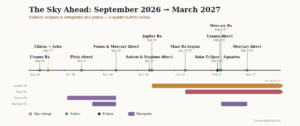
From September 2026 into early 2027, the current planetary positions favor review over launch. Saturn and Neptune sit in Aries, Uranus in Gemini, Jupiter in Leo, and Pluto in Aquarius. A Venus retrograde and a Mercury retrograde close out 2026, several planets station direct in December, and 2027 opens with a long Mars retrograde (Jan 10 to Apr 1) plus an annular solar eclipse in Aquarius on February 6.
What planetary positions actually tell you
A planetary position is simply where a planet sits in the zodiac at a given moment. The planet tells you the theme, and the sign tells you the flavor.
Here’s the reframe that makes this useful instead of anxious. The planets are not a control panel wired to your life. They’re a clock. They tell you which psychological theme the collective is being asked to work on right now, the way a season tells you it’s time to plant or harvest without forcing your hand.
Mercury governs how we think and talk. Venus governs love and value. Mars governs desire and drive. Jupiter governs growth, Saturn governs structure, and the slow outer planets shape the long themes of a whole era. Reading the current planetary positions isn’t fortune-telling. It’s orientation.
You don’t need the sky to tell you your future. You need it to tell you which conversation the moment is having, so you can have it on purpose.
Where the planets are right now
As of September 2026, the slow-moving backdrop is unusually loaded, and it sets the tone for everything ahead.
Saturn and Neptune are both in Aries, rebuilding identity from the ground up. Saturn asks you to act without a template; Neptune dissolves the old self-image. Uranus is in Gemini, which doesn’t just electrify how we communicate; it actively fries our attention span. It turned retrograde on September 10, turning information anxiety and cognitive overload into the collective diagnosis for the next few months.
Jupiter is in Leo, expanding confidence and the courage to be seen. And Pluto continues its slow march through Aquarius, transforming the systems of power. But it’s also quietly rewiring the psychology of belonging: as technology connects the masses, actual human intimacy feels colder and more distant than ever.
That’s the stage. Now here’s the sequence of scenes playing out on it between now and spring.
What’s ahead through the end of 2026
The last stretch of 2026 is dominated by review, and two retrogrades do most of the work.
The Venus and Mercury retrogrades
Venus turns retrograde from October 3 to November 13, moving back through Scorpio and Libra. This is the heavy one for the heart. It reopens questions of love, worth, and value, and it tends to send old lovers back to your door.
Mercury then turns retrograde from October 24 to November 13 in Scorpio, layering a communication audit on top. Which of these hits your love life hardest is its own question, broken down in which retrograde affects relationships most, and the mechanics of the Mercury cycle live in what Mercury retrograde actually means.
The December turning point
Then the year pivots. Pluto stations direct in mid-October. Then, in December, three slow planets change gear almost at once: Saturn turns direct on the 10th, Neptune on the 12th, and Jupiter turns retrograde on the 13th. After months of external pressure, the work quietly moves inward, and the growth Jupiter was pushing outward in Leo starts asking to be consolidated instead of expanded.
Q1 2027: the review quarter
If late 2026 was about reviewing love and words, the first quarter of 2027 is about reviewing action itself. This is the part of the current planetary positions worth planning around now.
Mars retrograde is the headline
Mars stations retrograde on January 10, 2027 and stays retrograde until April 1, moving back from Virgo into Leo. It’s the first Mars retrograde in two years, and it colors the entire quarter. Desire and drive turn down, momentum stalls, and buried conflict comes up to be dealt with. It’s a poor window for launching anything new. It’s an excellent one for revising what’s broken, especially the systems and habits that looked fine on paper but have quietly been draining you. And if you notice a partner going distant instead of fighting during this stretch, that’s the classic withdrawal broken down in why zodiac signs pull away.
A February eclipse and one more Mercury review
February brings an acceleration point. An annular solar eclipse in Aquarius on February 6 reopens the collective-versus-personal theme the 2026 eclipses started. Uranus turns direct on February 8, freeing up the communication front again. Then Mercury turns retrograde one more time, February 9 to March 3, backing from Pisces into Aquarius. The quarter closes on yet another review of what’s been said and left unsaid.
Put together, the message of early 2027 is consistent and a little humbling: slow down, finish, and revise. The sky is not handing out green lights this quarter. It’s handing out second looks.
Will all the planets align?
Short answer: no, not in the movie sense. The planets will not form a single glowing line, and nothing in this window supports the doomsday version circulating online.
What’s actually true is subtler. Several slow planets sit in fire and air signs at once and change direction within days of each other in December, so the chart looks unusually active. That’s the real “alignment” people are sensing. Not a cosmic event happening to you, but a rare clustering of shifts you get to respond to.
How to use the current planetary positions
Knowing the map is useless if you read it as a sentence instead of a question. The move is always the same. Identify which theme is active, then ask what it wants you to look at, instead of waiting for it to happen to you.
And because the sky changes daily, the single most practical habit is to check where the planets actually are before you interpret your week. And because the sky changes daily, the single most practical habit is to check exactly where the planets are before you interpret your week. Pull up a reliable transit chart and match the actual positions against what you’re feeling, instead of absorbing whatever the internet is panicking about that day.
This whole stretch is one long invitation to finish things. The planets aren’t blocking you. They’re asking you to close the loops before you open new ones.
That’s a more sobering read than “the universe has a plan,” and it’s also more empowering, because it puts you back in charge. How each of these positions lands on you personally depends on your own chart, and the truest starting point is your rising sign.
Questions people keep asking
As of September 2026, Saturn and Neptune are in Aries, Uranus is in Gemini, Jupiter is in Leo, and Pluto is in Aquarius. The Moon changes signs every few days. Because the faster planets move constantly, today’s exact positions are best confirmed on a live tracker.
It depends on the date. Uranus is retrograde from September 10, 2026, then Venus retrogrades October 3 to November 13 and Mercury October 24 to November 13. In 2027, Mars is retrograde January 10 to April 1 and Mercury again February 9 to March 3.
The long Mars retrograde from January 10 to April 1, 2027 defines the first quarter, turning it into a period for revision rather than new action. An annular solar eclipse in Aquarius on February 6 is the other major marker, reopening collective-versus-personal themes.
No. There is no literal single-file planetary alignment in this window, and no basis for the doomsday claims about one. What is real is that several slow planets cluster in fire and air signs and change direction close together, which makes the chart look unusually active.
So here’s the honest question underneath every “what’s happening astrologically right now” search. Are you looking for the sky to explain your life? Or for permission to finally finish the thing you already know is waiting to be closed? Because this whole stretch was built for exactly that.
The map only matters once you know where you stand on it. Start with how you’re personally wired to meet all this change, beginning with decoding your rising sign.